Sunday, 26 June 2011

Bhutan - Cheaper eggs

Increase in domestic egg supply, price hiked after Bhutan stopped import of poultry and its products following an outbreak of bird flu in India, dragged down the price.

The precautionary measure also encouraged poultry farm in the country. There are almost 150 poultry farm in Tsirang, which lead to an increase in the supply of eggs and decrease in price. Price of eggs has reduced by 50 percent. Prevailing price of an egg is Nu. 4.

There is an apprehension among small farmers, low price and rising cost of poultry feed, could force them out of business.

Poultry farm owner said,” the price went down drastically in the last three weeks,” Dorji Drukpa added, “low price is barely enough to maintain the farm.” The price for a cartoon of eggs was Nu. 1,600 in the past and now farmer fetch around Nu 1,200.

The eggs are mostly market in Thimphu.

Thursday, 23 June 2011

Bhutan - IT Park vandalised

The properties of under-construction Thimphu IT Park in Serbithang was vandalised by a group of boys referred to as Babesa gang. The incident happened in the early morning of June 20.

A gang of 15-20 boys slashed around 300 cement bags, cut off electric wires, broke window panes, burnt documents, destroyed fire pumps and drilled holes in two synthetic plastic tanks.

Based on the circumstantial evidences, the police has detained second year student of Royal Thimphu College.

The police have connected the case to an incident that happened few days back. An unemployed youth was caught stealing iron rods from the site by security guards. The boy was handed over to the police.

The college student had visited the construction site in the following morning inquiring about the boy caught in act of stealing. He had warned the security guards of possible revenge by “Babesa gang”.

The very night, around 2:00 am, two groups of boys entered the site from different directions. One group distracted the security guards and other damaged the properties.

The police found canvas shoes that appeared like the shoe print left at the crime scene in the house of detainee. The forensic experts are yet to confirm this claim.

Currently, the forensic experts are on elections duty. The claim will be verified after their return.

The act of vandalism is expected to delay the completion of IT Park on time. The Project Director, Gautam Nandy is wary about the fact.

“More than the monetary losses, it is a huge loss of time.”

The boys had also threatened the guards and workers to discontinue working on the site at the time of attack. The project director fear that workers might leave following the threat.

The project has not estimated the cost of the damage.


Wednesday, 15 June 2011

Bhutan - The significance of Parinirvana


Perspective 15 June, 2011 - Every fifteenth day of the fourth month in the Bhutanese calendar is observed as Lord Buddha’s Parinirvana, formally known as Duechen Ngazom. Among many great deeds of the historical Buddha Shakyamuni recorded, there are twelve most important deeds, most famous among which five are included in the Parinirvana.

A summarisation from the first deeds
When the Buddha was teaching in the paradise of Tushita, which is a realm where the devas (gods) reside and also a sambhogakaya realm, the sound of his previous motivation reminded him that it was necessary to take birth in our world and teach the dharma.

He then considered five things: the land where he ought to be born (which was Kapila in Nepal), the caste he should be born into (which was a royal caste), the family in which he should be born (which was the Shakya clan), who his mother was to be (she was Mayadevi), and the time that was right for him to be born (which happened to be when the five degenerations were on the increase, the present time).

After having made these determinations, he decided to take birth in our world. This particular deed of leaving Tushita was intended to teach us that somebody, who has achieved enlightenment, is no longer a slave of his own karma, and has control over anything he or she does.

The Buddha was conceived into the womb of his mother, Mayadevi (by taking the form of a White Elephant descending from Tushita and entering the womb immaculately). One may wonder why he was conceived and then took birth. If he had complete control over everything, then why wasn’t he born miraculously from a lotus flower as was Padmasambhava?

The Buddha had a special reason for being born the normal way. He was thinking in the long term of his future disciples, who would be inspired because the Buddha, who practised and achieved enlightenment, started out like anyone else. He did this to instill conviction and confidence in his future disciples.

Third Deed: Birth in the garden of Lumbini, in present day Nepal
Although the Buddha took an ordinary human birth, there was still something special in his birth. The Buddha came out of the body of his mother through her right side. Some people might wonder how this was possible. They might think, “Well, what exactly happened? Did the rib cage crack?” One doesn’t need to think in terms of anatomical problems, because the Buddha was a miraculous being and he just took birth through his mother’s right side without any pain or obstacle.

At the time of the Buddha’s birth, there were many very special things happening where he was born. All of a sudden, crops started growing. Trees appeared all over the area of Lumbini and rare flowers, such as the Udumvara flower, that had never grown in this area, started blooming everywhere. Due to these events, he was given the name Siddhartha in Sanskrit, or Dhon Drup in Tibetan, which means, “the one that makes everything possible”.

As a result of interdependent origination, the presence of a highly accomplished individual produces changes in the environment, such as the blossoming of flowers.

Ninth Deed: Victory over of the leader of Maras, Papiyan
When the Buddha was sitting under the bodhi tree Papiyan, the leader of Maras, used forms related to the three disturbing emotions (sometimes called kleshas) of ignorance, desire, and aggression to try and lure the Buddha away from his pursuit of enlightenment. The first deception, representing ignorance, was that the Buddha was asked to abandon his meditation and return immediately to the kingdom, because his father King Shuddhodana had died and the evil Devadatta had taken over the kingdom.

Then Papiyan tried to create an obstacle using desire; his beautiful daughters tried to deceive and seduce the Buddha. When this did not disturb the Buddha’s meditation, Mara then used hatred by coming towards the Buddha surrounded by millions of horribly frightening warriors, who were throwing weapons at the Buddha’s body. But the Buddha wasn’t distracted or fooled by these three poisons. He remained immersed in compassion and loving-kindness and therefore triumphed over this display of the three poisons and was able to eventually achieve enlightenment. (This deed of the Buddha is represented by the image of the Buddha “taking the earth as witness,” gently touching the ground with his right hand and holding a begging bowl in his left hand.

Tenth Deed: Attaining enlightenment under the bodhi tree
Since the Buddha developed all the qualities of meditation to the utmost stages, he was able to reach enlightenment. He did this to demonstrate that we also can reach enlightenment. As a matter of fact, one of the main points of the whole Buddhist philosophy is to show us that Buddhahood is not something to be found outside of us, but something we can achieve by looking inside ourselves. And the qualities that we attain with enlightenment will be no different from the ones the Buddha attained. Also, the Buddha managed to eliminate all the negative emotions, the same ones we presently experience.

Twelfth Deed: Passing away at the age of 83 in the town of Kushingara
The Buddha and his monks came to a grove of sal trees in Kushinagar. The Buddha asked Ananda to prepare a couch between two trees, with its head to the north. I am weary and want to lie down, he said. When the couch was ready, the Buddha lay down on his right side, one foot upon the other, with his head supported by his right hand. Then the sal trees bloomed, although it was not their season, pale yellow petals rained down on the Buddha. The Buddha spoke for a time to his monks. At one point, Ananda left the grove to lean against a door post and weep. The Buddha sent a monk to find Ananda and bring him back. Then the Blessed One said to Ananda, Enough, Ananda! Do not grieve! Have I not taught from the very beginning that with all that is dear and beloved there must be change and separation? All that is born, comes into being, is compounded, and is subject to decay. How can one say: “May it not come to dissolution”? This cannot be.

Ananda, you have served the Tathagata with loving-kindness in deed, word, and thought; graciously, pleasantly, wholeheartedly. Now you should strive to liberate yourself.

The Blessed One then praised Ananda in front of the other assembled monks.

The Buddha spoke further, advising the monks to keep the rules of the order of monks. Then he asked three times if any among them had any questions. Do not be given to remorse later on with the thought: “The Master was with us face to face, yet face to face we failed to ask him.” But no one spoke. The Buddha assured all of the monks they would realise enlightenment.

Then he said, All compounded things are subject to decay. Strive with diligence. Then, serenely, he passed into Parinirvana.

Contributed by Choten Dorji
Lecturer in Buddhist Studies (English) Lekjung Institute for Higher Buddhist Studies Punakha

Sunday, 12 June 2011

Bhutan - 25 promoted as colonels


His Majesty the King today promoted 25 lieutenant colonels of the armed forces to the rank of colonels. This includes 14 Lt. Colonels from the Royal Bhutan Army, seven from the Royal Body Guards and four from the Royal Bhutan Police.

The officers received Tashi Khadhar from His Majesty the King at the throne room of the Tashichhodzong.

Following that, His Majesty granted an audience to the officers and their family members at the courtyard of the dzong.

Tuesday, 7 June 2011

Bhutan - Poland-Bhutan friendship association formed

A friendship association has been formed in Poland.

The Poland-Bhutan Friendship Society was launched in Warsaw, Poland on May 25 under the auspices of Her Majesty the Queen Mother, Ashi Dorji Wangmo Wangchuck.

While in Poland, Her Majesty launched the Polish version of her book, “Treasures of the Thunder Dragon”.

The event was attended by prominent personalities from a cross section of the Polish society, government officials. The launch of the Poland-Bhutan friendship Association and was covered by all the major TV and print media.

Her Majesty expressed confidence that the Poland-Bhutan friendship Association would play an important role in creating greater awareness about Bhutan and lead to better and closer relations between Bhutan and Poland.

Sunday, 29 May 2011

Bhutan - Keeping Thimphu clean, a gargantuan task

Keeping Thimphu clean and beautiful seems like a distant dream, at least for now. Despite several cleanup campaigns and measures put in place by the Thimphu City Corporation, Thimphu city is not getting any cleaner.

The sidewalks and roads are strewn with papers and plastic wrappers, the drains are clogged with plastic bottles, and the walls of shops and buildings are smeared with doma spit and lime.

Phub Dorji, a Thimphu resident, said “most of the goods are wrapped in plastic of paper. People throw away the wrappings carelessly.”

The Thimphu City Corporation has deployed 16 workers to clean the streets. They work the whole daylong, seven days a week to keep the streets clean.

Budhiman Tamang, one of the cleaners, said “I have been cleaning the streets for 25 years now; the garbage only seems to grow. We clean today and tomorrow, there will be even more garbage.”

Chandra Bahadur Darjee has been cleaning the streets for 21 years. “We start work at 6am and continue till 4 pm. The waste doesn’t seem to become less.”

Ten garbage collecting trucks move around the city collecting waste. Gyeltshen Dukpa, the city corporation’s chief environmental officer, believes that the city will remain the same despite their efforts unless the residents assume responsibility and develop civic sense.

Thimphu is the capital. Most of the residents are educated. It is home to the country’s elite but it seems asking them to do their bit is asking too much.

Wednesday, 25 May 2011

Bhutan - Bhutan Nepal trade talks

Bhutan and Nepal began talks in the capital Thimphu today to draft a trade agreement between the two neighbouring countries.

Trade between Bhutan and Nepal has been growing steadily though there is no formal trade agreement.

In 2008, the volume of trade between the two countries is estimated at Nu.324 million. The next year it grew to Nu. 455 million and to Nu.625 million in 2010.

The two day meeting will draft the trade agreement, the protocol to the agreement, rules of origin, and the list of exportable items of the respective countries.

The Director of Department of Trade Sonam P Wangdi is leading the Bhutanese delegation. The Nepalese delegation is led by the Joint Secretary of the Ministry of Commerce and Supplies Toya Narayan Gyawali.

Sunday, 22 May 2011

Bhutan - ~The Royal Couple~

Our Druk Gyalpo with Jetsun Pema, the future Queen of Bhutan.


Cr : Facebook ~His Majesty King Jigme Khesar Namgyel Wangchuck ~

Friday, 20 May 2011

Bhutan - His Majesty’s address to the 7th session of parliament today


It is now almost three years and three months since the start of democracy. Our nation has so much to be proud of. The first years of democracy have been a great success, made possible by the blessings of the Dharma and our Guardian Deities and the foundations laid through the selfless efforts of our forefathers and Kings and the good fortune and karma of the People of Bhutan.

Our generation embarked on a profound process of democratization, with little experience but armed with the strength of our unity of vision and aspirations. Our people, government, religious institutions and bodies, private sector, media, legislature, constitutional bodies, judiciary and the armed forces have all served the country well under this new system, and have worked to slowly shape a strong and effective democracy. Through your hard work, it has been possible in the midst of such a dramatic transition to oversee the vast socio-economic development plans and projects we had in the 10th 5-year plan.

The government has worked tirelessly in all sectors such as hydropower, tourism, agriculture and industries. Remote villages are being connected with roads and electricity is being made accessible to villages while education and health facilities are being broadened or improved. Our traditions and cultural values continue to be strengthened and rural lhakangs are being renovated. The government has moved with intensified efforts to renew foreign relations according to the changing times. I am happy that our relations with India are as strong as ever. The people of Bhutan must appreciate all these efforts being made by the government.

In spite of all our achievements and the peace and prosperity we have experienced for so long – in fact because of this success – we must remember to never be complacent. If even a small fraction of the problems that plague other nations appear in Bhutan, our small society will be forever afflicted and we may never regain our jewel of a nation.

As we move forward, we must be guided by the most sacred and unchanging national goals – the security and sovereignty of our Nation and the peace, unity and harmony of our People. Today, as I have said before, our immediate and foremost duty is the success of democracy. That is our foundation for the future success of Bhutan. But democracy can only flourish if all Bhutanese uphold the rule of law; if there is good governance; if corruption is eradicated and if the delivery of public services is fair and effective.

As a small landlocked nation, the only way for us to fulfill these is to carry out our duties through cooperation, sharing and consultation. I know that each ministry, government institution, parliamentary body or public agencies has its own mandate. Still, you must work together, not in competition. Henceforth, I ask all of you to establish the practice of meeting regularly, sitting face to face every now and then, so that you will always be in collaboration as you carry out your separate responsibilities. And all problems may be resolved without being allowed to fester and grow.

Such shared effort will be in the true spirit of Gross National Happiness.

Today, at this auspicious gathering, I would like to make a short announcement to all the people of the 20 Dzongkhags.

As King, it is now time for me to marry. After much thought I have decided that the wedding shall be later this year.

Now, many will have their own idea of what a Queen should be like – that she should be uniquely beautiful, intelligent and graceful. I think with experience and time, one can grow into a dynamic person in any walk of life with the right effort. For the Queen, what is most important is that at all times, as an individual she must be a good human being, and as Queen, she must be unwavering in her commitment to serve the People and Country.

As my queen, I have found such a person and her name is Jetsun Pema. While she is young, she is warm and kind in heart and character. These qualities together with the wisdom that will come with age and experience will make her a great servant to the nation.

This union does not mean that I am starting my own family. From the very day I received the Dhar Ngay-Nga from the sacred Machhen, the people of the 20 Dzongkhags became my family. Such is the duty and privilege of all Kings of Bhutan. It is through this union, that I shall have a Queen who will support, and work with me, as I serve the People and Country.

The wedding will be in accordance with age-old tradition, to seek the blessings of our Guardian Deities. I ask the government not to make any plans for a grand celebration. The happiness of my beloved father and the blessings of our People will give me the greatest joy and happiness.

Friday, 13 May 2011

Bhutan - Bhutan and Maldives sign Air Services Agreement

Bhutan and the Maldives have signed an Air Services Agreement, paving the way for the two high-end tourist destinations to be connected by direct flights or flights transiting through other countries in the region.

The flight details and routes will be worked out between the airlines of the two countries, one a tourist hot spot on the roof of the world and the other an ultimate destination for those interested in sunbathing and deep sea diving.

The Maldives Minister for Transport and Communication, Mohamed Adil Saleem, and the Secretary for Information and Communications in Bhutan, Dasho Kinley Dorji, signed the agreement on May 8, 2011. They emphasised the fact that air connectivity was vital for tourism and broader economic development. High-end tourists could find the connection a very attractive possibility with the tourism industry viewing both countries as niche markets.

Bhutan, which saw about 40,000 tourists last year, is currently building three new domestic airports. The Maldives, which is constructing its third international airport, has achieved an escalation of tourist numbers to about 800,000 tourists a year and is still expanding.

With Bhutan holding the chairmanship of SAARC, the agreement is also a step forward in one of SAARC’s goals, to connect all the capitals of the region.

Friday, 6 May 2011

Bhutan - His Majesty issues Kasho on Local Goverment Elections

During the audience granted to those who had appealed against their disqualification, His Majesty the King said that their appeal and the submissions made by the Prime Minister on behalf of the National Assembly, National Council and the two political parties, was with regard to the failure of the respective political parties to abide by the laws on procedures for de-registration in particular and on the interpretation of the laws on de-registration in general. Thus, the appeal would merit full consideration from the relevant agencies, if the individuals had themselves acted in accordance with the laws.

His Majesty said that the Election Commission of Bhutan was simply abiding by the Constitutional requirement that Local Governments must be apolitical. His Majesty said, “I have always encouraged political participation and the growth of political parties. Having heeded my request to all citizens to participate in the political process in the past, you may now, as prospective candidates for Local Government offices, be surprised that your participation in political parties have hindered your chances to run for office in Local Government. The Constitution requires apolitical Local Governments for very important reasons. Local Government responsibilities are very different from those of political parties or any other institution. Local Governments are the foundation for grassroots democracy. They must have intimate knowledge of the daily lives of the people in their constituencies; work in constant and close interaction with their people and nurture cooperation, consensus and close-knit communities. In a largely rural country Local Governments are even more important not just in carrying out vital duties towards achieving development objectives of their people, but also in bringing about a harmonious society.”

His Majesty said, “As individuals, having a preference for a political party is not bad. The majority of people will always hold certain preferences. However, in carrying out one’s duties as part of an apolitical institution, we must keep our political affiliations aside. It is as simple as carrying out one’s official duties without being biased by preference for family and friends at the cost of the larger community.”

His Majesty said that he always encouraged institutions to resolve issues on their own, through consultation. He said, “Once the Throne is involved, the Throne will protect the Constitution and the laws in place – it has no other path before it.”

His Majesty said that, “the sacred Constitutional duty of the King is to protect and uphold this Constitution in the best interest and for the welfare of the people of Bhutan. As I do so, I shall seek if necessary, the Supreme Court’s opinion, for the Supreme Court is the guardian of this Constitution and the final authority of its interpretation.”

Sunday, 1 May 2011

Bhutan - Hope for Radhi farmers


Irrigation project 1 May, 2011 - Radhi farmers could live up to their name- rice bowl of eastern Bhutan, once the major irrigation revival program in the gewog is completed, by the end of this year.

After the irrigation canal built in the early 1980s, measuring over three kilometers in length and dug out by excavators was damaged by landslides at several places, farmers became totally dependent on the monsoon.

“We had hopes that it would solve the problem forever but landslides took away the intake source of the canal and we’re left wanting for water,” a farmer from Jonla village, Ngawang Tshering said. It was funded by international fund for agriculture development (IFAD).

The revival plan is to use huge polythene pipes in places where the original canal was washed away. The survey is complete and Trashigang dzongkhag engineers are working on the designs. The canal has a new in take source and would use over three and a half kilometer of pipes mostly in places prone to slides.

“It requires drilling in to rocks and even using rods at the source of the canal to strengthen it,” dzongkhag engineer Chador Phuntsho said.

Radhi Gup Samdrup said most of his gewog’s paddy fields rely on irrigation canals drawn from monsoon fed streams. “Despite the fact that most of our land is paddy fields, there has always been irrigation water shortage,” he said.

The project would be funded from funds allocated for activities in the gewog that were dropped from the 10th Plan. As an additional fund, Speaker of the National Assembly and member of parliament from Radhi, Tshogpon Jigme Tshultim had approved his constitutional development grant for the project.

He said the new canal would bring great relief to farmers. Of the 775 households in the gewog, it is expected to benefit over 450 spread over 12 chiwogs.

“It would also allow farmers to do winter cropping,” he said.

Farmers said that they had suffered severely, over the past decades; from dry spells as monsoon showers were either delayed or poor. To make things worse, their irrigation canals broke down repeatedly because of loose soil.

Radhi gewog’s rice yield decreased by over 30 percent in 2009 mainly because of lack of rain. Ngawang Tshering said as his fields were located at the bottom of the village, he received little water, as he is the last to receive among 20 households. “I have to depend mostly on the monsoon for transplantation,” the farmer from Jonla village said. As water shortage grew acute farmers started to convert their paddy fields in to dry land to grow maize. The project would solve his problems.

However, the gup said that the canal would not reach one village in the gewog, Tongling, as it on the other side of the hill. Farmers said that some villagers in Tongling have left their fields fallow because of the shortage of water.

By Tshering Palden

http://www.kuenselonline.com

Tuesday, 26 April 2011

Bhutan - His Majesty grants audience to the Indian Minister of State for Defence


His Majesty the King granted an audience to the Indian Minister of State for Defence Dr. Mangapati Pallam Raju yesterday.

He arrived in the Kingdom on Sunday for a two day visit.

He is in the Kingdom to attend DANTAK’s golden jubilee celebration.

Dr Raju also called on the Prime Minister Lyonchhoen Jigmi Y. Thinley at the Gyalyong tshokhang yesterday.

He will be leaving the Kingdom today.

Saturday, 23 April 2011

Bhutan - Traveling to Bhutan, the Mystical Land of the Thunder Dragon

If you have the cash saved up, a little time and planning can get you to this land locked Himalayan Kingdom and open up a wonder world of picturesque landscapes, enchanting villages, snow capped mountains, ageless forests, erotic sculptures, dark musty monasteries and a culture so rich and steeped in time you will think you have indeed been transported back a few hundred years.

Firstly you have to get to Paro. The government imposed rule is that you must fly at least one way with the National Carrier, Druk Air. As Druk is actually the only carrier that flies into Paro, Bhutan's airport, then the choice is easy. Druk flies a couple of times a week from Kathmandu, Bangkok and Dehli.

Booking your trip is no easy task with so many online tour operators all offering package tours to Bhutan. The Government of Bhutan has set a daily tariff fee for foreigners visiting the country. Many people confuse this with the visa fee and think that is what costs so much. In fact the visa to visit Bhutan is only US$25. Tours are expensive due to the imposed daily tariff.

Many companies offer what look like value for money Bhutan Tours, but inspect the itineraries closer, especially for tours that commence in places like Kathmandu, Bangkok or Delhi, they may include your flight to Paro, but check out how many days you will actually be spending inside Bhutan as that is where the money should be spent. Some tour agents fluff out tours by selling a ten day trip, where only five days may actually be in Bhutan and the rest doing sightseeing around the joining point country.

Look for a tour that you can meet in Paro, making your own way there will ensure that you get 100% value for money inside Bhutan. If you book a tour with an agent they will most likely be able to help you with arranging your flights.


The best time to visit Bhutan is of course the main festival seasons where the culture and colour is at its best. During these times, normally March, April, September and October, it can be very hard to book a flight. So make sure you book well ahead and get your agent to arrange and confirm flights for you (most airlines can be booked up to 10 months in advance only). Also double check that if you are booking your tour to coincide with a festival, that you will get the chance to see one. During these festival times the tariff rate will be at a premium. If festivals are not your thing, then try going outside of season and you should be able to get as much as a 30% discount on your tour.

As a trip to Bhutan is such a 'once in a lifetime experience' a true travel investment you should choose your tour operator wisely. As all tours to Bhutan are pre arranged, it's all too easy for a travel company to tack Bhutan tours onto their list of tours without having properly made contacts with agents inside Bhutan. As Bhutan tours are 100% operated by Bhutanese tour companies, you should be looking for a company that either represents a Bhutan Agent or is a certified tour operator for Bhutan. I could not think of anything worse than spending a lot of money and not getting to see half the things mentioned on the itinerary or having a poorly arranged holiday.

When planning your trip, obviously your budget will factor the amount of days you are able to spend in Bhutan. Here are a few places that you must see, so make sure that your itinerary and time frame covers them.

Kichu Lhakhang- This Monastery is one of the 108 monasteries built across the Himalayan region by the Tibetan King to subdue the Demoness that lay across the Himalayan region.

Taktsang Monastery- The Tigers Nest. This is one of the most famous sights in Bhutan. The monastery is perched on a cliff in the midst of a lush green jungle. It is reached by a short walk and offers stunning views. This is one of the most memorable sights to visit in Bhutan and the main reason why a lot of visitors come here. The primary Lhakhang was built around Guru Rimpoche's meditation cave in the 1684 by the Penlop of Paro Gyaltse Tenzin Rabgay, this incredible monastery clings to the edge of a sheer rock cliff that plunges 900 meters into the valley below. Legend has it that Guru Padmasambhava, the tantric mystic who brought Buddhism to Bhutan, flew here on the back of a flying tiger, Dorji Drolo, said to be his favorite consort.

The Tango Monastery- The trail Tango is a climb of 280 meters and it takes an hour to reach the monastery. Lama Gyalwa Lhanampa founded the monastery in 12th century. The building was re-built in 15th century by the "Divine Madman". This is one of the best places for meditation in Bhutan.
Chimi Lhakhang- Built by Lama Drukpa Kuenley in 15th century. (This monk is popularly known as the Devine Madman for his philosophy, "Salvation through sex"). He subdued the demons with his "Magical Thunder bolt". The Temple is also known as "The Temple of Fertility". Sterile women from far and wide come to this Temple to get blessed.

Wangdiphodrang Dzong- Built in 1638. Legend has it as the people were searching for the site of this Dzong, four ravens were seen flying away in four directions. This was considered an auspicious sign, representing the spread of religion to the four points of the compass.

Chendebji Monastery- This Monastery is patterned after Swayambhunath in Kathmandu and was built in the 19th century by Lama Shida, from Tibet, to cover the remains of an evil spirit that was killed at this spot.
Trongsa Dzong- I think that this is the most impressive fort in Bhutan. The present form was built in 1644 and was built in aim to unify Eastern Bhutan. The Dzong, which means fort in Bhutanese is the present home of the Royal Family and the first two hereditary kings who rule the country from this place.

Gangtey Gompa - This is famous for the Black Necked Cranes during winter. These cranes are very rare and endangered and highly protected by the Government. These cranes fly to Phobjikha valley which is their winter habitat. The Cranes circle three times in a clock-wise direction around the Gangtey Gompa as a reverence to the Monastery before landing in the valley. They repeat the same practice before flying back to Tibet in early spring.

Sunday, 17 April 2011

Bhutan - A King’s Gun


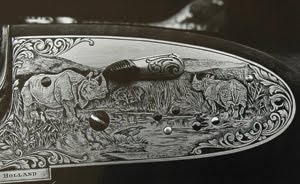
17 April, 2011 - A Holland & Holland gun is considered as among the finest of modern times. It is known for its brilliant craftsmanship and today is one of the world’s most expensive handcrafted sports gun.

There is one such gun in Bhutan. It is a .458 double barrel. With engravings of the big game animals of Bhutan, it is the only of its kind and now worth more than £ 80,000.

The fourth king received it as his coronation gift in 1974. The managing director of the gun company, Malcolm Lyell, travelled from London to personally offer it. Lyell’s handwritten notes says, “The official day for present giving was Tuesday, June 4th but the King couldn’t wait! We were summoned the day before and presented it to him in the Royal Cottage.”

The third King, Jigme Dorji Wangchuck, had ordered the gun two years earlier in 1972, before he passed away. The third king first met Lyell in 1949, in London at the Westley Richards’s gun showroom where, as Crown Prince, he had gone to buy hunting rifles. Ever since, the two gun enthusiasts maintained their friendship.

The doyen of the London gun trade visited Bhutan as the guest of the king. He first came in 1970 and was one of the earliest to trek extensively in our northern mountains. Using hand-drawn maps of botanist Frank Ludlow, Lyell and his family made four such expeditions into the then largely unknown northern mountains. Lyell was a game enthusiast and keen on wild animals and, during his treks, saw and recorded many of these wild animals namely, the blue sheep, blue bear, wild yaks, takins, and snow leopards.

The Gun
In 1972, after returning from one such trip, Lyell had the gun of our king engraved with the large game animals that he saw during his treks in Bhutan.

For example, the right lock plate has an engraving of a group of takins - the national animal. The fore feet and body of the lynx are also just visible on the “fence” (standing breach at the left hand end of the barrel).

The left lock has an engraving of the Indian rhinoceros, which are found in the foothills of Manas. The tail and back of the snow leopard are scarcely visible on the “fence”. A Tibetan antelope, found along the Chumbi valley border, is engraved on the trigger guard, and the grip cap has an engraving of a blue sheep or bhurel.

History
Crafting a Holland & Holland gun took a long time and this became a setback as the soaring inflation of the 1970s cut into the company’s profit.

To sustain the business, Lyell started to craft presentation guns. These guns were fully functional but, because of the intricate artwork, enhanced its costs, and hence inflation did not affect its value.

Inspired by the gun makers of the 18th century, Lyell came up with the rococo gun, with deep engravings in gold and silver of classical motifs, such as Diana the huntress.

In 1966, the Shooting Times described it as the finest gun of modern times and, from then, Lyell produced a series entitled “Products of Excellence”. These included such guns as the Set of Five; beautifully matched shotguns in every gauge from 12 bore to .410; the African hunters series of big game rifles; and finally the Saurian four bore, decorated with scenes of prehistoric life.

Almost two decades later, after the launch of the “product of excellence”, in 1972, our late king ordered the .458 double barrel gun, which he never saw. In the memory of the late king, Lyell had it engraved with the big game animals of Bhutan and presented it to our fourth king during his coronation. Malcolm Lyell died early this year.

Contributed by Tshering Tashi

http://www.kuenselonline.com

Tag : bhutan,king,gun