Sunday, 29 May 2011

Bhutan - Keeping Thimphu clean, a gargantuan task

Keeping Thimphu clean and beautiful seems like a distant dream, at least for now. Despite several cleanup campaigns and measures put in place by the Thimphu City Corporation, Thimphu city is not getting any cleaner.

The sidewalks and roads are strewn with papers and plastic wrappers, the drains are clogged with plastic bottles, and the walls of shops and buildings are smeared with doma spit and lime.

Phub Dorji, a Thimphu resident, said “most of the goods are wrapped in plastic of paper. People throw away the wrappings carelessly.”

The Thimphu City Corporation has deployed 16 workers to clean the streets. They work the whole daylong, seven days a week to keep the streets clean.

Budhiman Tamang, one of the cleaners, said “I have been cleaning the streets for 25 years now; the garbage only seems to grow. We clean today and tomorrow, there will be even more garbage.”

Chandra Bahadur Darjee has been cleaning the streets for 21 years. “We start work at 6am and continue till 4 pm. The waste doesn’t seem to become less.”

Ten garbage collecting trucks move around the city collecting waste. Gyeltshen Dukpa, the city corporation’s chief environmental officer, believes that the city will remain the same despite their efforts unless the residents assume responsibility and develop civic sense.

Thimphu is the capital. Most of the residents are educated. It is home to the country’s elite but it seems asking them to do their bit is asking too much.

Wednesday, 25 May 2011

Bhutan - Bhutan Nepal trade talks

Bhutan and Nepal began talks in the capital Thimphu today to draft a trade agreement between the two neighbouring countries.

Trade between Bhutan and Nepal has been growing steadily though there is no formal trade agreement.

In 2008, the volume of trade between the two countries is estimated at Nu.324 million. The next year it grew to Nu. 455 million and to Nu.625 million in 2010.

The two day meeting will draft the trade agreement, the protocol to the agreement, rules of origin, and the list of exportable items of the respective countries.

The Director of Department of Trade Sonam P Wangdi is leading the Bhutanese delegation. The Nepalese delegation is led by the Joint Secretary of the Ministry of Commerce and Supplies Toya Narayan Gyawali.

Sunday, 22 May 2011

Bhutan - ~The Royal Couple~

Our Druk Gyalpo with Jetsun Pema, the future Queen of Bhutan.


Cr : Facebook ~His Majesty King Jigme Khesar Namgyel Wangchuck ~

Friday, 20 May 2011

Bhutan - His Majesty’s address to the 7th session of parliament today


It is now almost three years and three months since the start of democracy. Our nation has so much to be proud of. The first years of democracy have been a great success, made possible by the blessings of the Dharma and our Guardian Deities and the foundations laid through the selfless efforts of our forefathers and Kings and the good fortune and karma of the People of Bhutan.

Our generation embarked on a profound process of democratization, with little experience but armed with the strength of our unity of vision and aspirations. Our people, government, religious institutions and bodies, private sector, media, legislature, constitutional bodies, judiciary and the armed forces have all served the country well under this new system, and have worked to slowly shape a strong and effective democracy. Through your hard work, it has been possible in the midst of such a dramatic transition to oversee the vast socio-economic development plans and projects we had in the 10th 5-year plan.

The government has worked tirelessly in all sectors such as hydropower, tourism, agriculture and industries. Remote villages are being connected with roads and electricity is being made accessible to villages while education and health facilities are being broadened or improved. Our traditions and cultural values continue to be strengthened and rural lhakangs are being renovated. The government has moved with intensified efforts to renew foreign relations according to the changing times. I am happy that our relations with India are as strong as ever. The people of Bhutan must appreciate all these efforts being made by the government.

In spite of all our achievements and the peace and prosperity we have experienced for so long – in fact because of this success – we must remember to never be complacent. If even a small fraction of the problems that plague other nations appear in Bhutan, our small society will be forever afflicted and we may never regain our jewel of a nation.

As we move forward, we must be guided by the most sacred and unchanging national goals – the security and sovereignty of our Nation and the peace, unity and harmony of our People. Today, as I have said before, our immediate and foremost duty is the success of democracy. That is our foundation for the future success of Bhutan. But democracy can only flourish if all Bhutanese uphold the rule of law; if there is good governance; if corruption is eradicated and if the delivery of public services is fair and effective.

As a small landlocked nation, the only way for us to fulfill these is to carry out our duties through cooperation, sharing and consultation. I know that each ministry, government institution, parliamentary body or public agencies has its own mandate. Still, you must work together, not in competition. Henceforth, I ask all of you to establish the practice of meeting regularly, sitting face to face every now and then, so that you will always be in collaboration as you carry out your separate responsibilities. And all problems may be resolved without being allowed to fester and grow.

Such shared effort will be in the true spirit of Gross National Happiness.

Today, at this auspicious gathering, I would like to make a short announcement to all the people of the 20 Dzongkhags.

As King, it is now time for me to marry. After much thought I have decided that the wedding shall be later this year.

Now, many will have their own idea of what a Queen should be like – that she should be uniquely beautiful, intelligent and graceful. I think with experience and time, one can grow into a dynamic person in any walk of life with the right effort. For the Queen, what is most important is that at all times, as an individual she must be a good human being, and as Queen, she must be unwavering in her commitment to serve the People and Country.

As my queen, I have found such a person and her name is Jetsun Pema. While she is young, she is warm and kind in heart and character. These qualities together with the wisdom that will come with age and experience will make her a great servant to the nation.

This union does not mean that I am starting my own family. From the very day I received the Dhar Ngay-Nga from the sacred Machhen, the people of the 20 Dzongkhags became my family. Such is the duty and privilege of all Kings of Bhutan. It is through this union, that I shall have a Queen who will support, and work with me, as I serve the People and Country.

The wedding will be in accordance with age-old tradition, to seek the blessings of our Guardian Deities. I ask the government not to make any plans for a grand celebration. The happiness of my beloved father and the blessings of our People will give me the greatest joy and happiness.

Friday, 13 May 2011

Bhutan - Bhutan and Maldives sign Air Services Agreement

Bhutan and the Maldives have signed an Air Services Agreement, paving the way for the two high-end tourist destinations to be connected by direct flights or flights transiting through other countries in the region.

The flight details and routes will be worked out between the airlines of the two countries, one a tourist hot spot on the roof of the world and the other an ultimate destination for those interested in sunbathing and deep sea diving.

The Maldives Minister for Transport and Communication, Mohamed Adil Saleem, and the Secretary for Information and Communications in Bhutan, Dasho Kinley Dorji, signed the agreement on May 8, 2011. They emphasised the fact that air connectivity was vital for tourism and broader economic development. High-end tourists could find the connection a very attractive possibility with the tourism industry viewing both countries as niche markets.

Bhutan, which saw about 40,000 tourists last year, is currently building three new domestic airports. The Maldives, which is constructing its third international airport, has achieved an escalation of tourist numbers to about 800,000 tourists a year and is still expanding.

With Bhutan holding the chairmanship of SAARC, the agreement is also a step forward in one of SAARC’s goals, to connect all the capitals of the region.

Friday, 6 May 2011

Bhutan - His Majesty issues Kasho on Local Goverment Elections

During the audience granted to those who had appealed against their disqualification, His Majesty the King said that their appeal and the submissions made by the Prime Minister on behalf of the National Assembly, National Council and the two political parties, was with regard to the failure of the respective political parties to abide by the laws on procedures for de-registration in particular and on the interpretation of the laws on de-registration in general. Thus, the appeal would merit full consideration from the relevant agencies, if the individuals had themselves acted in accordance with the laws.

His Majesty said that the Election Commission of Bhutan was simply abiding by the Constitutional requirement that Local Governments must be apolitical. His Majesty said, “I have always encouraged political participation and the growth of political parties. Having heeded my request to all citizens to participate in the political process in the past, you may now, as prospective candidates for Local Government offices, be surprised that your participation in political parties have hindered your chances to run for office in Local Government. The Constitution requires apolitical Local Governments for very important reasons. Local Government responsibilities are very different from those of political parties or any other institution. Local Governments are the foundation for grassroots democracy. They must have intimate knowledge of the daily lives of the people in their constituencies; work in constant and close interaction with their people and nurture cooperation, consensus and close-knit communities. In a largely rural country Local Governments are even more important not just in carrying out vital duties towards achieving development objectives of their people, but also in bringing about a harmonious society.”

His Majesty said, “As individuals, having a preference for a political party is not bad. The majority of people will always hold certain preferences. However, in carrying out one’s duties as part of an apolitical institution, we must keep our political affiliations aside. It is as simple as carrying out one’s official duties without being biased by preference for family and friends at the cost of the larger community.”

His Majesty said that he always encouraged institutions to resolve issues on their own, through consultation. He said, “Once the Throne is involved, the Throne will protect the Constitution and the laws in place – it has no other path before it.”

His Majesty said that, “the sacred Constitutional duty of the King is to protect and uphold this Constitution in the best interest and for the welfare of the people of Bhutan. As I do so, I shall seek if necessary, the Supreme Court’s opinion, for the Supreme Court is the guardian of this Constitution and the final authority of its interpretation.”

Sunday, 1 May 2011

Bhutan - Hope for Radhi farmers


Irrigation project 1 May, 2011 - Radhi farmers could live up to their name- rice bowl of eastern Bhutan, once the major irrigation revival program in the gewog is completed, by the end of this year.

After the irrigation canal built in the early 1980s, measuring over three kilometers in length and dug out by excavators was damaged by landslides at several places, farmers became totally dependent on the monsoon.

“We had hopes that it would solve the problem forever but landslides took away the intake source of the canal and we’re left wanting for water,” a farmer from Jonla village, Ngawang Tshering said. It was funded by international fund for agriculture development (IFAD).

The revival plan is to use huge polythene pipes in places where the original canal was washed away. The survey is complete and Trashigang dzongkhag engineers are working on the designs. The canal has a new in take source and would use over three and a half kilometer of pipes mostly in places prone to slides.

“It requires drilling in to rocks and even using rods at the source of the canal to strengthen it,” dzongkhag engineer Chador Phuntsho said.

Radhi Gup Samdrup said most of his gewog’s paddy fields rely on irrigation canals drawn from monsoon fed streams. “Despite the fact that most of our land is paddy fields, there has always been irrigation water shortage,” he said.

The project would be funded from funds allocated for activities in the gewog that were dropped from the 10th Plan. As an additional fund, Speaker of the National Assembly and member of parliament from Radhi, Tshogpon Jigme Tshultim had approved his constitutional development grant for the project.

He said the new canal would bring great relief to farmers. Of the 775 households in the gewog, it is expected to benefit over 450 spread over 12 chiwogs.

“It would also allow farmers to do winter cropping,” he said.

Farmers said that they had suffered severely, over the past decades; from dry spells as monsoon showers were either delayed or poor. To make things worse, their irrigation canals broke down repeatedly because of loose soil.

Radhi gewog’s rice yield decreased by over 30 percent in 2009 mainly because of lack of rain. Ngawang Tshering said as his fields were located at the bottom of the village, he received little water, as he is the last to receive among 20 households. “I have to depend mostly on the monsoon for transplantation,” the farmer from Jonla village said. As water shortage grew acute farmers started to convert their paddy fields in to dry land to grow maize. The project would solve his problems.

However, the gup said that the canal would not reach one village in the gewog, Tongling, as it on the other side of the hill. Farmers said that some villagers in Tongling have left their fields fallow because of the shortage of water.

By Tshering Palden

http://www.kuenselonline.com

Tuesday, 26 April 2011

Bhutan - His Majesty grants audience to the Indian Minister of State for Defence


His Majesty the King granted an audience to the Indian Minister of State for Defence Dr. Mangapati Pallam Raju yesterday.

He arrived in the Kingdom on Sunday for a two day visit.

He is in the Kingdom to attend DANTAK’s golden jubilee celebration.

Dr Raju also called on the Prime Minister Lyonchhoen Jigmi Y. Thinley at the Gyalyong tshokhang yesterday.

He will be leaving the Kingdom today.

Saturday, 23 April 2011

Bhutan - Traveling to Bhutan, the Mystical Land of the Thunder Dragon

If you have the cash saved up, a little time and planning can get you to this land locked Himalayan Kingdom and open up a wonder world of picturesque landscapes, enchanting villages, snow capped mountains, ageless forests, erotic sculptures, dark musty monasteries and a culture so rich and steeped in time you will think you have indeed been transported back a few hundred years.

Firstly you have to get to Paro. The government imposed rule is that you must fly at least one way with the National Carrier, Druk Air. As Druk is actually the only carrier that flies into Paro, Bhutan's airport, then the choice is easy. Druk flies a couple of times a week from Kathmandu, Bangkok and Dehli.

Booking your trip is no easy task with so many online tour operators all offering package tours to Bhutan. The Government of Bhutan has set a daily tariff fee for foreigners visiting the country. Many people confuse this with the visa fee and think that is what costs so much. In fact the visa to visit Bhutan is only US$25. Tours are expensive due to the imposed daily tariff.

Many companies offer what look like value for money Bhutan Tours, but inspect the itineraries closer, especially for tours that commence in places like Kathmandu, Bangkok or Delhi, they may include your flight to Paro, but check out how many days you will actually be spending inside Bhutan as that is where the money should be spent. Some tour agents fluff out tours by selling a ten day trip, where only five days may actually be in Bhutan and the rest doing sightseeing around the joining point country.

Look for a tour that you can meet in Paro, making your own way there will ensure that you get 100% value for money inside Bhutan. If you book a tour with an agent they will most likely be able to help you with arranging your flights.


The best time to visit Bhutan is of course the main festival seasons where the culture and colour is at its best. During these times, normally March, April, September and October, it can be very hard to book a flight. So make sure you book well ahead and get your agent to arrange and confirm flights for you (most airlines can be booked up to 10 months in advance only). Also double check that if you are booking your tour to coincide with a festival, that you will get the chance to see one. During these festival times the tariff rate will be at a premium. If festivals are not your thing, then try going outside of season and you should be able to get as much as a 30% discount on your tour.

As a trip to Bhutan is such a 'once in a lifetime experience' a true travel investment you should choose your tour operator wisely. As all tours to Bhutan are pre arranged, it's all too easy for a travel company to tack Bhutan tours onto their list of tours without having properly made contacts with agents inside Bhutan. As Bhutan tours are 100% operated by Bhutanese tour companies, you should be looking for a company that either represents a Bhutan Agent or is a certified tour operator for Bhutan. I could not think of anything worse than spending a lot of money and not getting to see half the things mentioned on the itinerary or having a poorly arranged holiday.

When planning your trip, obviously your budget will factor the amount of days you are able to spend in Bhutan. Here are a few places that you must see, so make sure that your itinerary and time frame covers them.

Kichu Lhakhang- This Monastery is one of the 108 monasteries built across the Himalayan region by the Tibetan King to subdue the Demoness that lay across the Himalayan region.

Taktsang Monastery- The Tigers Nest. This is one of the most famous sights in Bhutan. The monastery is perched on a cliff in the midst of a lush green jungle. It is reached by a short walk and offers stunning views. This is one of the most memorable sights to visit in Bhutan and the main reason why a lot of visitors come here. The primary Lhakhang was built around Guru Rimpoche's meditation cave in the 1684 by the Penlop of Paro Gyaltse Tenzin Rabgay, this incredible monastery clings to the edge of a sheer rock cliff that plunges 900 meters into the valley below. Legend has it that Guru Padmasambhava, the tantric mystic who brought Buddhism to Bhutan, flew here on the back of a flying tiger, Dorji Drolo, said to be his favorite consort.

The Tango Monastery- The trail Tango is a climb of 280 meters and it takes an hour to reach the monastery. Lama Gyalwa Lhanampa founded the monastery in 12th century. The building was re-built in 15th century by the "Divine Madman". This is one of the best places for meditation in Bhutan.
Chimi Lhakhang- Built by Lama Drukpa Kuenley in 15th century. (This monk is popularly known as the Devine Madman for his philosophy, "Salvation through sex"). He subdued the demons with his "Magical Thunder bolt". The Temple is also known as "The Temple of Fertility". Sterile women from far and wide come to this Temple to get blessed.

Wangdiphodrang Dzong- Built in 1638. Legend has it as the people were searching for the site of this Dzong, four ravens were seen flying away in four directions. This was considered an auspicious sign, representing the spread of religion to the four points of the compass.

Chendebji Monastery- This Monastery is patterned after Swayambhunath in Kathmandu and was built in the 19th century by Lama Shida, from Tibet, to cover the remains of an evil spirit that was killed at this spot.
Trongsa Dzong- I think that this is the most impressive fort in Bhutan. The present form was built in 1644 and was built in aim to unify Eastern Bhutan. The Dzong, which means fort in Bhutanese is the present home of the Royal Family and the first two hereditary kings who rule the country from this place.

Gangtey Gompa - This is famous for the Black Necked Cranes during winter. These cranes are very rare and endangered and highly protected by the Government. These cranes fly to Phobjikha valley which is their winter habitat. The Cranes circle three times in a clock-wise direction around the Gangtey Gompa as a reverence to the Monastery before landing in the valley. They repeat the same practice before flying back to Tibet in early spring.

Sunday, 17 April 2011

Bhutan - A King’s Gun


17 April, 2011 - A Holland & Holland gun is considered as among the finest of modern times. It is known for its brilliant craftsmanship and today is one of the world’s most expensive handcrafted sports gun.

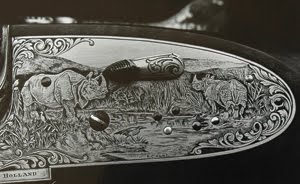
There is one such gun in Bhutan. It is a .458 double barrel. With engravings of the big game animals of Bhutan, it is the only of its kind and now worth more than £ 80,000.

The fourth king received it as his coronation gift in 1974. The managing director of the gun company, Malcolm Lyell, travelled from London to personally offer it. Lyell’s handwritten notes says, “The official day for present giving was Tuesday, June 4th but the King couldn’t wait! We were summoned the day before and presented it to him in the Royal Cottage.”

The third King, Jigme Dorji Wangchuck, had ordered the gun two years earlier in 1972, before he passed away. The third king first met Lyell in 1949, in London at the Westley Richards’s gun showroom where, as Crown Prince, he had gone to buy hunting rifles. Ever since, the two gun enthusiasts maintained their friendship.

The doyen of the London gun trade visited Bhutan as the guest of the king. He first came in 1970 and was one of the earliest to trek extensively in our northern mountains. Using hand-drawn maps of botanist Frank Ludlow, Lyell and his family made four such expeditions into the then largely unknown northern mountains. Lyell was a game enthusiast and keen on wild animals and, during his treks, saw and recorded many of these wild animals namely, the blue sheep, blue bear, wild yaks, takins, and snow leopards.

The Gun
In 1972, after returning from one such trip, Lyell had the gun of our king engraved with the large game animals that he saw during his treks in Bhutan.

For example, the right lock plate has an engraving of a group of takins - the national animal. The fore feet and body of the lynx are also just visible on the “fence” (standing breach at the left hand end of the barrel).

The left lock has an engraving of the Indian rhinoceros, which are found in the foothills of Manas. The tail and back of the snow leopard are scarcely visible on the “fence”. A Tibetan antelope, found along the Chumbi valley border, is engraved on the trigger guard, and the grip cap has an engraving of a blue sheep or bhurel.

History
Crafting a Holland & Holland gun took a long time and this became a setback as the soaring inflation of the 1970s cut into the company’s profit.

To sustain the business, Lyell started to craft presentation guns. These guns were fully functional but, because of the intricate artwork, enhanced its costs, and hence inflation did not affect its value.

Inspired by the gun makers of the 18th century, Lyell came up with the rococo gun, with deep engravings in gold and silver of classical motifs, such as Diana the huntress.

In 1966, the Shooting Times described it as the finest gun of modern times and, from then, Lyell produced a series entitled “Products of Excellence”. These included such guns as the Set of Five; beautifully matched shotguns in every gauge from 12 bore to .410; the African hunters series of big game rifles; and finally the Saurian four bore, decorated with scenes of prehistoric life.

Almost two decades later, after the launch of the “product of excellence”, in 1972, our late king ordered the .458 double barrel gun, which he never saw. In the memory of the late king, Lyell had it engraved with the big game animals of Bhutan and presented it to our fourth king during his coronation. Malcolm Lyell died early this year.

Contributed by Tshering Tashi

http://www.kuenselonline.com

Tag : bhutan,king,gun

Tuesday, 5 April 2011

Bhutan - Two men caught with Black Panther bones and skin


Police have apprehended two men for smuggling Black Panther bones and skin. They are from Tsamang in Monggar.

The two men were arrested last night in Thimphu while they were trying to deliver the smuggled goods to their counterparts in Thimphu. Black Panther is a highly endangered big cat.

They are found in warmer places in Bhutan. The Black Panther bones and the skin have been handed over to the department of forest for further investigation.

http://www.bbs.com.bt/bbs/?p=4494


Wednesday, 30 March 2011

Bhutan - Weaving a new way of life


Weavers from Kheng Gongdu and Silambi Geogs in Monggar are learning how to use Mechi loom. The Mechis are a tribal people in Assam, India. Like our weavers from Kheng Gongdu and Silambi, they are known for the nimbleness of their fingers and the dexterity in weaving. The textile designs are also similar. There is only one difference. Their looms are much larger and reportedly easier to handle.

Weavers from Kheng Gongdu and Silambi use the traditional back-strap looms which is also used by weavers all over Bhutan.

Forty five-year-old Sangay Dema from Silambi is one of the 20 weavers who are attending the month long training. She said “it is easier and faster than our back strap loom. We don’t get back ache.” She now plans to use the Mechi loom and also teach other weavers in her village.

Twenty one-year-old Leki Chozom is from Khen Gondu. She is learning how to weave for the first time. “I learnt tailoring first and then weaving. One month is not enough for me to learn everything. I am lagging behind my friends. We started together.”

The training is being conducted by Monhini Sageer-ri. She is happy with the progress though the training has to be conducted in sign language.

“They can’t speak Hindi or Nepali and I don’t speak their language so we communicate through sign language.”

The experienced weavers are learning faster than the new ones. She also believes that one month may not be enough for new learners.

“Maybe in two months, they can learn everything there is to learn. The older weavers pick up faster than the younger ones”

Organised by the weaving center at Turlling in Monggar, rural women attend the training in the morning and NFE learners in the evening.

http://www.bbs.com.bt/bbs/?p=4469


Sunday, 27 March 2011

Bhutan - His Majesty arrives in Bangladesh

His Majesty the King has arrived in Bangladesh on a four day state visit.

His Majesty is visiting Bangladesh as the Guest of Honour at the 40th Anniversary of Independence and the National Day of Bangladesh.

His Majesty was received by President Zillur Rahman at the Shahjalal International Airport and presented a 31 gun salute followed by a guard of honour.

His Majesty the King is accompanied by the Works and Human Settlement Minister, Lyonpo Yeshey Zimba and Major General Dhendup Tshering.

http://www.bbs.com.bt/bbs/?p=4411

Monday, 21 March 2011

Bhutan - Bhutan chips in

Japan Earthquake 19 March, 2011 - Bhutan has contributed USD one million to Japan as an assistance to the relief efforts, following the recent earthquake and tsunami in the country that killed thousands and rendered many homeless.

A three-day Dolma Jigpa Gyedchob ceremony also started in shedras, drubdeys, lhakhangs and goendeys across the country yesterday for the deceased and affected families.

Yangpai lopen Chimmi said the ritual will benefit and promote deliverance of the departed souls. Dolma (Tara) meant one who protects, and Jigpa stood for fearsome calamities and sufferings. Gyedchob referred to someone, who protects from eight forms of disaster and sufferings.

Home Minister Minjur Dorji said the prayers were conducted in hope that they would help those, who left the world and those, who are still suffering.

“We extend our deepest sympathies to the people of Japan,” he said. “We are as bereaved.”

On March 13, His Majesty, members of the royal family, cabinet ministers and senior government officials joined in a special prayer session and the lighting of 1,000 butter lamps at Tashichhodzong.

By Tashi Tenzin


Thursday, 17 March 2011

Bhutan - His Majesty graces Paro Tshechu

Thursday, March 17, 2011

His Majesty the King today joined thousands of people from Paro and the neighbouring districts and camera totting tourists at the Paro Tshechu.

The Paro Tshechu, an annual event, is one of the most popular festivals in the country and attracts thousands of people every year. It also draws thousands of tourists from all over the world who time their visit to coincide with the tshechu.

Today’s highlights were the Wochupai Zhey, Durdag, Tungam, Pholay Molay and Shaw Shachi mask dances.

His Majesty also visited the Goenkhang of Paro Rinpung Dzong and offered prayers and met with the geog leaders of the dzongkhag. The tshechu will end on Saturday with the unfurling of Guru Thongdrol.

http://www.bbs.com.bt/bbs/?p=4330

Tag : bhutan,paro tshechu,tshechu,King of Bhutan